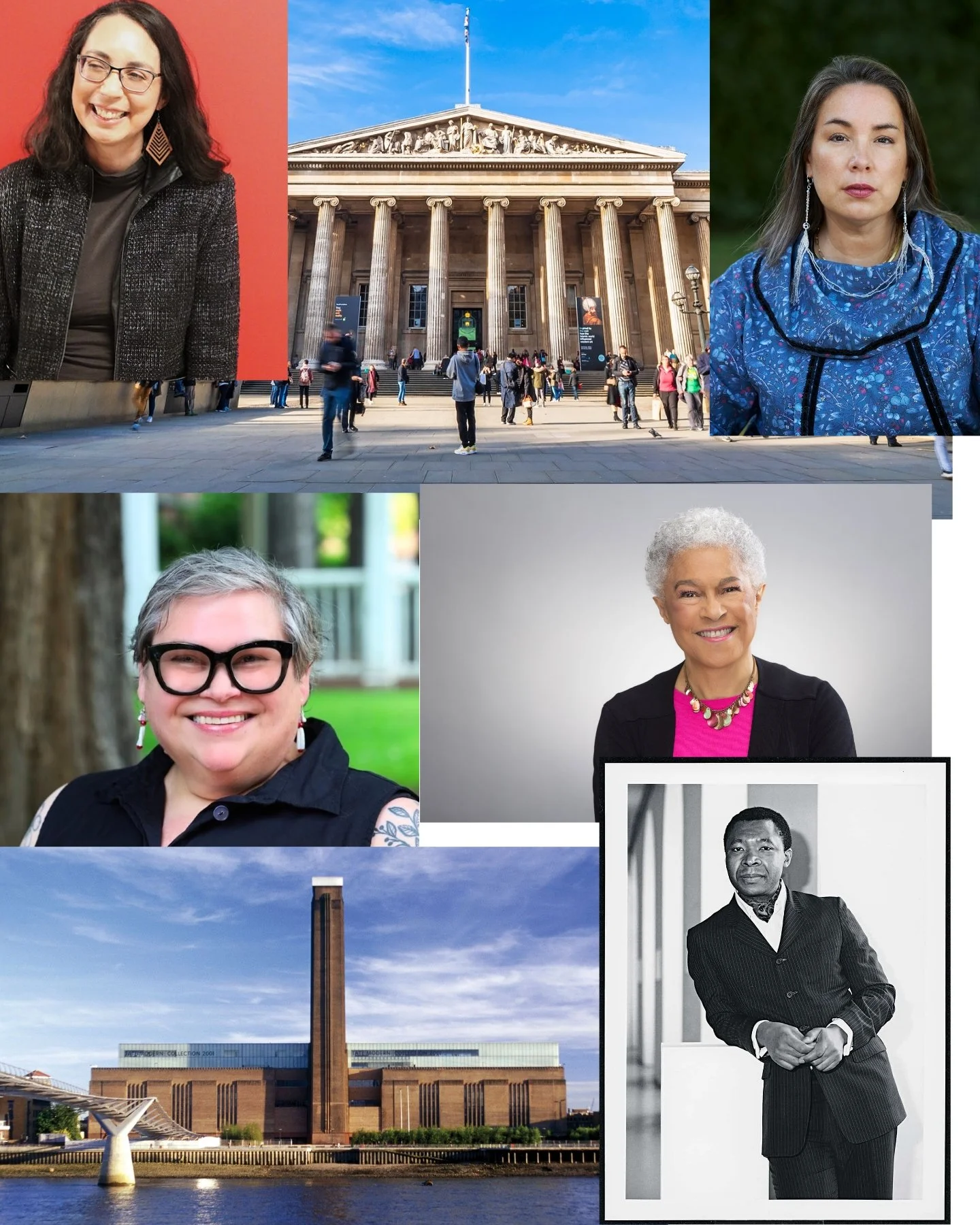
In January 2019, I undertook a research project in London, inspired by curator and art historian Okwui Enwezor’s (1963-2019) 2003 essay “The Postcolonial Constellation: Contemporary Art In a State of Permanent Transition”. In this essay, Enwezor discusses the opening of the Tate Modern in London in 2000, and states that "...globalization and cultural assimilation are operative in the art world…”.[1]
Though Enwezor dealt directly with art and the Tate Modern in his essay, my research encompasses the British Museum for its influence as a lauded historical institution which displays art, natural, and cultural objects, and its problematic history in cultural display. My research consisted of examining the current presentations of non-Western art and cultural objects in the Tate Modern and British Museum in an attempt to understand what colonial roots are still visible and operative in these influential museums nearly twenty years after Enwezor’s essay was written.[2]
The goal of this piece is to look to epistemologies and philosophies such as Afrocentric and Indigenous Feminisms in order to build a frame of possibility for more decolonized (which may lead to what I believe are more ethical) methods of display within art and encyclopedic museum institutions.
This theoretical work relies more heavily on experiential knowledge, co-creation, and co-existing truths, than the empiricism or philosophical rationalism upon which Western standards of knowledge have evolved. I utilize my London research in addition to various academic resources to connect the structures of power within museums and methods of display (past and current), and trace the origins of these museum practices to their foundation in Enlightenment philosophical and imperialist colonial practices inspired by the European Age of Discovery.
From the 15th-17th centuries, European nations launched into global exploration that focused on the exploration of places outside of Europe and the Mediterranean, primarily for the purposes of trade and colonization, now referred to as the Age of Discovery or Age of Exploration. With this exploration, came the practice of amassing collections of “exotic” objects (often called Wunderkammern or cabinets of curiosity). These collections were intended to construct a microcosm of the world at large as a means to study the natural and man-made world, and as a status symbol of those who accumulated these objects.
The choices of what to collect and how to describe the objects collected was highly personal, influenced by the beliefs and ideals of the collectors, and often had no grounding in even rudimentary scientific or realistic research at the time. Brown University’s Joukowsky Institute for Archaeology & the Ancient World points to “...the collector’s treatment of a piece of coral.” as an example.
Because few people were familiar with coral in its natural environment, they invented definitions based on their personal ideologies. Therefore, the question of how to define coral could be approached from a medical, superstitious, scientific, or purely aesthetic point of view. Some used coral as a treatment for anemia; others kept it as a talisman against being struck down by lightning, or the evil eye; naturalists debated whether to classify it as mineral or animal; and finally, those with an eye for aesthetics simply arranged it based on its brilliant red hue….the personal level of choice involved in collecting was representative of the range in scientific and religious values at this time.[3]
These cabinet collections, which usually included books and artwork, lay the foundation for public encyclopedic (and later art) museums in Western Europe and the United States. In addition to the collecting impulses inspired by the earlier Age of Discovery, museum institutions developed largely as a result of the spread of Enlightenment values throughout the Western world in the 17th and 18th centuries.[4] [5]
Associated with such lauded historical figures as Rene Descartes, Francis Bacon, Denis Diderot, Voltaire, Jean-Jacques Rousseau, and John Locke, The Enlightenment was a 17th and 18th century European and North American ideological movement which attempted to make sense of and order the world through research, experimentation, and taxonomy, according to the social norms and morals of upper class, learned gentlemen.[6]
The movement utilized “...classical intellectual themes drawn from the mythology of Greece and imperial Rome to illustrate concerns of the eighteenth-century Enlightenment and to establish their legitimacy.”[7] Late 19th and early 20th century British philosopher Bertrand Russell described the Enlightenment as a “widespread ideological desire for critical thought and empirical proof in response to the uber-religiousiosity and superstitiousness of the 16th century.”[8]
This period prized skepticism, individualism, and rationalism. In order to promote these principles, Enlightenment-era thinkers such as Francis Bacon (a man who held the belief that “...no learned gentleman should be without a ‘cabinet’.”)[9] and Isaac Newton (a scientist who developed the theory of gravity, but also practiced theology and alchemy)[10], attempted to represent “what truly is” through objectivity, and developed methodologies such as The Scientific Method to avoid bias and achieve true neutrality.[11] These present lofty goals, however, the reality is that inherent biases and prejudices have always informed the outcomes of observations, classifications, and "scientific discovery".[12] [13]
As an example, during the 18th and 19th centuries, the habit of collecting often extended beyond natural, cultural, and artistic objects to what Europeans classified as “exotic” people or their remains. Non-European (and specifically non-white) people were often brought to Europe to be shown as “exhibits''.[14] This practice occurred alongside the highly biased ethnographic anthropological study of non-Europeans and often informed entire societal attitudes toward outside cultures.[15] This can be seen through the practices of racial and gender-based scientific studies, used to racialize slavery and assert the supremacy of land-owning, white men over other races and genders. Such was the case of Sarah ``Saartjie" Baartman.
Sarah Baartman (1770s-1815) was a South African woman living during the late 18th and early 19th centuries who was taken to London from Cape Colony, South Africa by Hendrik Cesaars (a free black man), and William Dunlop (a doctor who worked in the slave colony) ostensibly as an indentured servant.[16] She was then exhibited as an exotic specimen under the name “Hottentot Venus”.[17]
After Baartman’s death in 1815, her body was dissected by Georges Cuvier (1769-1932), a professor of anatomy who was searching for the “missing link” in evolution between apes and humans. While Baartman was alive, “Cuvier and [Henri] de Blainville [another comparative anatomist] were particularly keen to view Baartman’s labia. Their interest stemmed from traveler’s tales that Khoekhoe [sic] women had large buttocks and hypertrophied labia…”[18] [19] Cuvier once stated that he had never “...seen a human head more similar to the monkeys than hers.”[20]
Anatomical images like those drawn by Cuvier, and promotional images of Baartman were then utilized by scientists such as Julien-Joseph Virey (1775-1846), a French naturalist and anthropologist as a basis for dehumanizing racialized biological stereotypes such as the supposed “sexual primitivism” of black African women.[21] Attitudes such as these were founded by utilizing supposedly unbiased scientific methodology, and informed larger societal attitudes regarding race and gender.
Georges Cuvier “...preserved her [Baartman’s] skeleton and pickled her brain and genitals, placing them in jars…”[22] which were made available for display in le Muséum des sciences naturelles d'Angers (est. 1801), and displayed next to a cast of her body showcasing her prominent buttocks for visitors.[23]
These remains were moved to le Musée de l'Homme from its opening in 1937 until the 1970s, and were later returned to her homeland the Gamtoos Valley, in 2002, after a formal request by the South African government was finally acceded to by France.[24] [25] The display of both Baartman’s living body and her posthumous remains indicate that those who exhibited and studied her did not afford her the same position of humanity that they themselves occupied, and based on their erroneous interpretations of “science” informed by their own systems of value.
In the views of learned, white, European men like Cuvier and Virey, their standards of humanity were supported by methodologies of science which came from the Enlightenment. In their minds, Baartman iconized the image of black African women, and her physical attributes came to pathologize and stereotype the behavior and traits of all black women. Scientists using “unbiased” methods, (perhaps subconsciously) inserted their own bias, and achieved “proof” that white Europeans were at the apex of the biological, and therefore social and economic hierarchy, thus establishing a white, European (male) standard and permitting those who don’t fit the paradigm to be exploited as non-human.[26] According to cultural historian Sander Gilman, these men theorized that, “The antithesis of European sexual mores and beauty is embodied in the black, and the essential black, the lowest rung on the great chain of being, is the Hottentot.”[27]
Even after the deaths of Cuvier and Virey, other highly respected scientists would continue the legacy of scientific racism. English scientist Charles Darwin, famous for his theories of evolution in nature, was inspired by the Scottish Enlightenment of the late 18th/early 19th centuries (and likely, though not recorded, by the work of Virey and Cuvier). In his 1871 book The Descent of Man, and Selection in Relation to Sex, Darwin applies his theories to the human race. He “...describes Australians, Mongolians, Africans, Indians, South Americans, Polynesians, and even Eskimos as “savages”, stating that the “highest races and the lowest savages” differ in “moral disposition … and in intellect”.[28]
These self-appointed “objective” fields of knowledge would come to establish the structural foundations for Western culture at large, forming what 20th and 21st-century sociologist and philosopher Patricia Hill Collins deems the “domains of power” of a “Eurocentric, Masculinist Knowledge Validation Process”[29]:
Two political criteria influence the knowledge validation process. First, knowledge claims are evaluated by a community of experts whose members represent the standpoints of the groups from which they originate. Within the Eurocentric masculinist process this means that a scholar making a knowledge claim must convince a scholarly community controlled by white men that a given claim is justified. Second, each community of experts must maintain its credibility as defined by the larger group in which it is situated and from which it draws its basic, taken-for-granted knowledge. This means that scholarly communities that challenge basic beliefs held in the culture at large will be deemed less credible than those, which support popular perspectives.[30]
What Collins signals here are intellectual and societal value systems rooted in The Enlightenment which form imperialist hegemonies according to the values and attributes held by those in power--in this case, those held by educated, white, Euro-American, upper/middle-class, largely-heterosexual men.[31]
Through the bestowal of collection and research practices, and structured knowledge systems, the intellectual and cultural values formed by this population during The Enlightenment, have shaped the basis for our modern-day systems of government, education, acceptable scientific methods of research, and medical procedure. Through these societal structures, domains of power have been established which then informed museum methodologies of collection and display.[32] By collecting exotic objects (and objets d’art), much like their Age of Discovery antecedents, these men attempted to bring order to the world. These collections were shared with fellow gentlemen, and later, through the founding of now-famous institutional collections, with the public.
18th century Europe saw the inception of famous extant ethnographic museums such as The British Museum (London, England, est. 1753) and Le Musée du Louvre (Paris, France, est. 1793). These were influenced by even earlier institutions established in Italy and Germany.[33]
Upon gaining independence as a nation-state in 1776, The United States would follow in Europe’s footsteps, founding public institutions such as the The Peabody Essex Museum (PEM) in Salem, Massachusetts in the 18th century, and the Metropolitan Museum of Art (Met; New York, New York, est. 1870) in the 19th
century.[34] [35]
These cultural institutions were largely created by governments (with collections or money often donated by wealthy citizens) for the edification of the public and to aid in the definition and preservation of a national identity. Their foundation coincided with colonial and imperial projects that sent European and American militaries, scientists, and settlers abroad, bringing back "exotic" goods--including foreign flora and fauna, cultural objects, people, and art--from the colonies to the metropole.[36]
Although much has changed in Western museum functionality and methodology since their foundation in the 18th and 19th centuries, many of the collections and display conditions of non-Western (and non-dominant population) art in the West still show their Enlightenment values and colonial roots.[37] [38] Not only does the act of collecting seek to inform, but it also seeks to exercise the dominance of Eurocentricity over “outside” cultures. This employment of power has long been publicly recognized by some museum professionals such as Karl Hutterer:
The act of collecting ethnographic specimens must be seen as an act of taking possession, both physically and symbolically, of some of the essence of individuals as well as whole societies and cultures. For the Third World, this aspect of private and museological collecting is just another element of the larger colonial context.[39]
The implied value that these authoritative institutions place on artworks and cultural objects is disseminated through what and how they choose to display. This technique of institutional legitimacy can work to define entire cultures via objects (rightly or wrongly) for the general museum-going public. In addition to influencing museum-goers, museum methodologies strongly impact adjoining fields in the Humanities, such as Art History, Anthropology, Sociology, History, and Archaeology due to the authoritative positions held by museums as purveyors of knowledge.[40]
But who makes these decisions? Institutions have become the anonymous behemoth to which we attribute all societal ills. While not without some grain of truth, what is not widely acknowledged, is that institutions are comprised of people, and therefore perpetuate the same biases held by individuals.
Stephen E. Weil once wrote that, “...museums are not and never can be as autonomous, as permanent, as inherently virtuous, or as broadly capable of serving an educational role as their more zealous advocates claim…”, and that “...the thrust of every museum is ultimately shaped by the dominant authority under which it operates.”[41] Since most museums (and other educational institutions) have been established in the traditions of knowledge originating in the Enlightenment (which were in turn influenced by the Eurocentric Age of Discovery) and have been educated within the structures of knowledge prioritized (as Hill Collins tells us) by, and which prioritizes a Eurocentric Masculinist point of view, then the fact that their collections, methods of collecting, and of display by and large reflect this should not come as a surprise.
In their 2017 National report, the American Alliance of Museums stated that 93% of museum directors and 46% of American museums boards are completely white.[42] One of the survey’s major findings was that:
Museum directors and board chairs believe board diversity and inclusion are important to advance their missions but have failed to prioritize action steps to advance these priorities…only 10% of directors indicate that their boards have developed a plan of action to become more inclusive.[43]
In the UK, statistics are only slightly better. 79% of permanent staff in Major Partner Museums and National Portfolio Organizations (public arts institutions) are listed as “White British or Irish” or “White Other” in the Arts Council England “Equality, Diversity, and the Creative Case” 2017-2018 data report. This data is incomplete, however, as some organizations choose not to report (“Prefer Not to Say”, with an unlisted quantity) and some are listed as simply “Unknown” (36%). According to the report, “Only 5% of staff at major partner museums are not white, “a longstanding issue which urgently needs addressing”.[44]
These statistics highlighting the lack of racial diversity within the permanent staff and boards of major museums and art institutions in the US and UK emphasizes how Western museums authorize what Okwui Enwezor calls an “overarching” point of view by institutional curators, directors, and board members. Enwezor points to the ways in which those who occupy positions of power in museums write and rewrite history for those who have been colonized and the descendants of colonizers.[45]
Our current historical moment--one which many call “Postcolonial”-- is a time when many museums are re-evaluating past and current practices.[46] As such, the question of how two of the world's most influential museums are working to reassess is exceedingly important.
A document entitled "What is African Art" by the British Museum's own Education Department states that, "As far as culture and art is concerned, ‘African' so often seems to be defined by people who are not African, including museum curators and art historians who identify themselves and their own cultural heritage as unambiguously European".[47] Does this document, which is directed toward educators, seek to call attention to past harm or simply mitigate current adherence to harmful curatorial standards and practices? Are these museums continuing with the highly ethnographic and Eurocentric practices recorded at the Tate by Enwezor nearly 20 years ago, or have they progressed to a new methodological standard? The only way to know for certain, was to conduct sustained, comprehensive field research at each museum in an effort to form a holistic snapshot of the current standards of curatorial practice in these institutions.
**End Excerpt**
________________
[1] Enwezor, Okwui. “The Postcolonial Constellation: Contemporaneity in a State of Permanent Transition”. Antinomies of Art & Culture: Modernity, Postmodernity, Contemporaneity, 2008. Nancy Condee, Okwui Enwezor, Terry Smith. Duke University Press. pp. 207-234.
[2] My research trip took place in London, January 2019, and was sponsored by an International Experience Grant from Smith College. Research was conducted in consultation with my major and concentration advisor, Frazer Ward, Smith College Art Department Professor, and Emma Chubb, Contemporary Art Curator at Smith College Museum of Art
[3] Faculty writer.“What is a Cabinet of Curiosities?”. Contemporary Issues in Archeological Theory. Joukowsky Institute for Archaeology & the Ancient World, Brown University. nd. Web
[4] Impey, Oliver R., MacGregor, Arthur, The Origins of Museums: The Cabinet of Curiosities in Sixteenth-and Seventeenth-Century Europe. Clarendon, Oxford, 1985, 2011.pp. xvii. Print
[5] Paul, Carole, ed. The First Modern Museums of Art: The Birth of an Institution in 18th and 19th Century Europe. Los Angeles: Getty Publications, 2012.p. Xi. Print.
[6] Walsh, Kevin. The Representation of the Past: Museums and Heritage in the Post-Modern World. London and New York, Routledge. 1992. p. 8-9, 18-20
[7] Outram, Dorinda. Panorama of the Enlightenment, 2006. Los Angeles : J. Paul Getty Museum
p. 10.
[8] Russell, Bertrand. A History of Western Philosophy. pp. 492–94
[9] Walsh, Kevin. The Representation of the Past: Museums and Heritage in the Post-Modern World. London and New York, Routledge. 1992. p. 18
[10] Josephson-Storm, Jason (2017). The Myth of Disenchantment: Magic, Modernity, and the Birth of the Human Sciences. University of Chicago Press. pp. 43 and Chapter 2, passim.
[11] Dominiczak, Marek H. “Science and Culture in the 18th Century: Isaac Newton”. Clinical Chemistry Mar 2012, 58 (3) 655-656 Vol. 58, Issue 3, March 2012
[12] Daston, Lorraine; Galison, Peter. Objectivity. New York, Zone Books. 2010
[13] Reiss, Julian and Sprenger, Jan, "Scientific Objectivity", The Stanford Encyclopedia of Philosophy (Winter 2017 Edition), Edward N. Zalta (ed.)
[14] Guido Abbattista and Giulia Iannuzzi, "World Expositions as Time Machines: Two Views of the Visual Construction of Time between Anthropology and Futurama," parts I-I2. World History Connected October 2016.
[15] Clair, Robin Patric. “The Changing Story of Ethnography”. Expressions of Ethnography
Novel Approaches to Qualitative Methods. New York, SUNY Press/Excelsior Editions. 2003. pp. 3-26. Print.
[16] Crais, Clifton C.; Scully, Pamela. Sara Baartman and the Hottentot Venus: A ghost story and a biography. Princeton and Oxford, Princeton University Press, 2009.
[17] “Hottentot” was a degrading term for the Khoikhoi and other black African, non-Bantu people of Southwest Africa, rooted in Old Dutch, and perpetuated by other Europeans; Jochen S. Arndt, 'What’s in a Word? Historicising the Term ‘Caffre’ in European Discourses about Southern Africa between 1500 and 1800', Journal of Southern African Studies (2017), 1-17.
[18] Qureshi, Sadiah. Peoples on Parade: Exhibitions, Empire, and Anthropology in Nineteenth Century Britain. Chicago, Chicago University Press, 2011. pp. 147. Book.
[19] “Khoekhoe” (also spelled “Khoikhoi”, formerly called “Hottentots”) are an Indigenous group of nomadic pastoral hunters in southwest Africa; Alan Barnard (1992). Hunters and Herders of Southern Africa: A Comparative Ethnography of the Khoisan Peoples. New York; Cambridge: Cambridge University Press.
[20] “Khoekhoe” (also spelled “Khoikhoi”, formerly called “Hottentots”) are an Indigenous group of nomadic pastoral hunters in southwest Africa; Alan Barnard (1992). Hunters and Herders of Southern Africa: A Comparative Ethnography of the Khoisan Peoples. New York; Cambridge: Cambridge University Press.
[21] Virey, Julien-Joseph, et al. Dictionnaire des sciences medicales, Par Une Societe de médecins et de chirurgiens . C.L.F. Panckouke, Ed. Paris, 1815.
[22] Parkinson, Justin. The Significance of Sarah Baartman. BBC News Magazine. January 7, 2016. Web
[23] Qureshi, Sadiah. Displaying Sara [sic] Baartman, the ‘Hottentot Venus’. History of Science. Volume 42: Issue 2, 2004. pp. 233
[24] Ibid.
[25] BBC News Staff Writer. "'Hottentot Venus' goes home". BBC News. 29 April 2002. Web.
[26] Pounder, C. C. H., Larry Adelman, Jean Cheng, Christine Herbes-Sommers, Tracy Heather Strain, Llewellyn Smith, and Claudio Ragazzi. 2003. Race: the power of an illusion. San Francisco, Calif: California Newsreel.
[27] Gilman, Sander L. (1985). "Black Bodies, White Bodies: Toward an iconography of Female Sexuality in Late Nineteenth Century Art, Medicine, and Literature". Critical Inquiry. The University of Chicago Press. 12 (1). p. 212.
[28] Darwin, Charles. The Descent of Man, and Selection in Relation to Sex. London, John Murray, 1871. p. 36.
[29] Collins, Patricia Hill. Black Feminist Thought: Knowledge, Consciousness, and the Politics of Empowerment. Routledge: New York and London. 1990. passim
[30] Ibid.
[31] A hegemony is a system of values put into place by dominant groups. It is enacted and re-enacted by normalizing and legitimizing certain systems of knowledge, culture, and behavior, while de-legitimizing others. In the case of Enlightenment values, the personal morals and social mores of the time informed the bodies of knowledge promoted as “neutral” and universal
[32] These values include, but are not limited to: What kinds of art is considered of value to society (high vs. low); the ways in which science is performed, and who, largely, is able to perform it; what cultures are deemed advanced versus primitive, and through this, what cultures have access to power.
[33] Paul, Carole, ed. The First Modern Museums of Art: The Birth of an Institution in 18th and 19th Century Europe. Los Angeles: Getty Publications, 2012. pp. viii, 48, 213. Print.
[34] PEM is a successor to the East India Marine Society, est.1799, the former Peabody Museum of Salem, est. 1915), and The Essex Institute (est. 1848). Pem.org. Web.
[35] Disturnell, John New York As It Was and As It Is. Archived January 1, 2016, at the Wayback Machine, D. Van Nostrand, New York, 1876. "Metropolitan Museum of Art", p. 101.
[36]. Impey, Oliver R., MacGregor, Arthur, The Origins of Museums: The Cabinet of Curiosities in Sixteenth-and Seventeenth-Century Europe. Clarendon, Oxford, 1985, 2011.pp. xvii. Print.
[37] Paul, Carole, ed. The First Modern Museums of Art: The Birth of an Institution in 18th and 19th Century Europe. Los Angeles: Getty Publications, 2012
[38] Sloan, Kim, ed. Enlightenment: Discovering the World in the Eighteenth Century. British Museum Press, 2003 (Part V: “Voyages of Discovery”).
[39] Hutterer, Karl. L. “The Sharing of Anthropological Collections: Cooperation With Third World Museums”.
Museum Anthropology 1980 vol:4 iss:5 p. 5.
[40] While the formal study of Art History has roots in the early Roman Empire with Pliny the Elder’s Naturalis Historia, the discipline was not firmly established until the 19th century when Heinrich Wölfflin (1864–1945) taught the subject at various universities in Germany and Switzerland.
[41] Weil, Stephen E. “Introduction”. Cabinet of Curiosities: Inquiries Into Museums and Their Prospects”. Washington, D.C. The Smithsonian Institution, 1995. p. xiii. Print.
[42] BoardSource, Museum Board Leadership 2017: A National Report. Washington, D.C.: BoardSource, 2017
[43] Elevado, Megan. “46% of American museum boards have no trustees of color. How can boards become more diverse?”. Marabou at the Museum. January 22, 2019.
[44] Arts Council England. Equality, Diversity, and the Creative Case: Data Report 2017-2018.
[45]Enwezor, Okwui. “The Postcolonial Constellation: Contemporaneity in a State of Permanent Transition”. Antinomies of Art & Culture: Modernity, Postmodernity, Contemporaneity, 2008. Nancy Condee, Okwui Enwezor, Terry Smith. Duke University Press. pp. 207-234.
[46] I use scare quotes around “Postcolonial”, because it is my belief that we do not exist in a postcolonial world, and that the methods of colonisation have merely shifted from a direct ownership of land (i.e. a “colony”), to a more subtle socio-economic and militarized version which retains control of land and peoples of supposedly “free” nations by means of military bases, outsourcing, resource control, and state-sponsored coups/the propping-up of dictatorships. These acts disproportionately benefit the same nations which colonized the now-freed lands and peoples to begin with.
[47] British Museum Education Department."What is African Art". britishmuseum.org n.d.