On the surface, the works in Jennifer Leigh Harrison’s show I’m Trying to Tell You Something: Breaking the Silence of Femicide Through Visual Art at Center on Contemporary Art (CoCA), belie the show’s heavy subject matter. In contrast, the work is light, largely abstract, not portraiture, with no obvious violence exhibited.
In fact, the only works featuring human subjects are a performance by Harrison and two videos, where she partners with performers from Seattle Pole Dance. A closer look, however, reveals that Harrison’s work utilizes a unique data visualization, in addition to educational wall labels, to tell the stories of intimate partner violence (IPV) against women.
One of the most powerful pieces in the show is Put A Pin In It, 2025. A large wall installation, featuring 4,970 dried gomphrena flowers (chosen for their ability to flourish in bleak conditions and their history as a symbol of immortality, as well as US settlers’ penchant for the flowers in the Colonial Period) in multiple shades of dark red and pink, illustrate the documented number of women who were murdered in 2021.
The massive work (84 x 84 x 5 inches) is abstract in form. The individual blossoms appear to gather into an amorphous arrangement which appears solid, with a few of the blooms lingering outside the dominant, almost cartographic form as if they are islands falling away from the mainland—or perhaps are racing to unite. The work is exquisite in its beauty, the delicate appearance of the flowers repudiating the horror they symbolize.
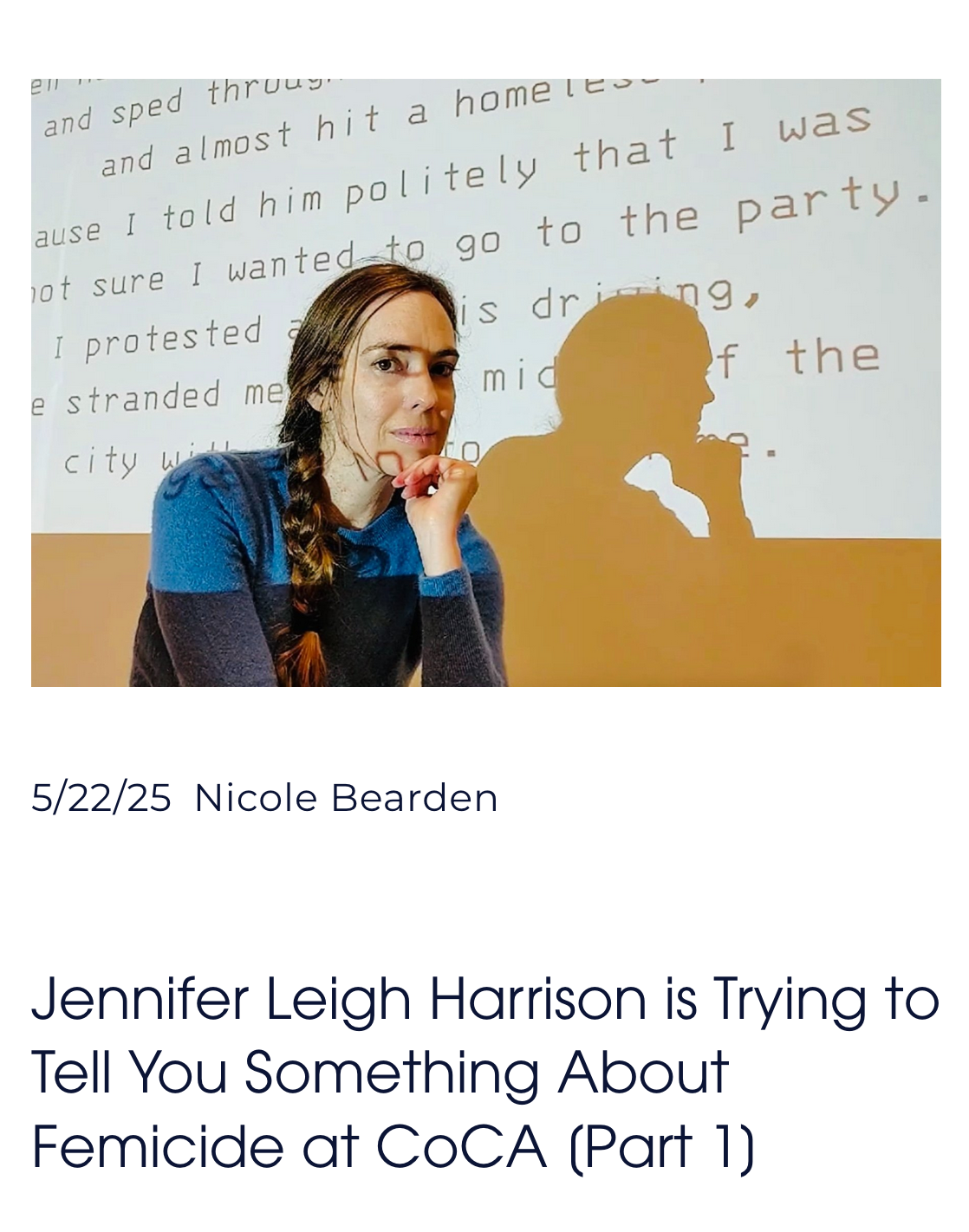
Immediately juxtaposed with this work is a stark projection, featuring quotes by abusers, politicians, survivors, and typical responses to women in situations of domestic violence. These words range from the seemingly innocuous, “It can’t be that bad if you’re still with him”, to statements connecting the violence of colonization to violence against women, to an abhorrent quote from 1995 by lawmaker Henry Aldridge declaiming that, “medically”, people who have been raped cannot get pregnant.
The projection light leaks over Put A Pin In It, the words on the wall nearly impossible not to read while viewing the installation of flowers—an allegory of how the stochastic violence and institution of misogyny casts an obscuring veil over the experiences of those touched by violence against women, an overlay of obfuscation that can extend even after death.
I had the chance to speak with Harrison about her show and her art, and she was kind enough to offer these thoughts:
Jennifer Leigh Harrison (JLH): There’s all this abstract art, and then there are these images, as if they are calling out in protest from across the room. I want to create disorientation. Why are these things together? As a therapist (and this is part of my somatic work), I want to bring the body back into the room and do that in a way that’s not celebrating violence, but celebrating autonomy and movement. Because movement is a path out.
I wanted to do an installation for a while now, and when it occurred to me that 4,970 women were killed in 2021, I was not going to do 4,970 marks. But pinning the flowers to the board was way more brutal, and it became very symbolic for me, because at the heart of this is that there is a labor involved of [sic] delivering information and facts in a way that, again, is like IPV. “Oh she’s so lovely, there is clearly nothing going on with her.” These flowers make a pretty flower installation, but the flowers I chose are prickly. They are difficult to pin down, and I thought that was really powerful.
When you’re working with death and grief, it is a labor. To do it and feel it—how do we put our bodies and labor into this work against gender-based violence to make it clear that labor and effort is required?
Wall labels give additional information on statistics, impact in various communities, and resources for viewers via QR codes, such as “Make a Safety Plan”, “IPV Homelessness”, and “Why Do People Stay?”. Viewers are free to engage with the art on a surface level, simply enjoy the work at face value, or delve as deep as their needs and interests allow.
In addition to being an artist, Jennifer Leigh Harrison, MSW, LICSW is a social worker and psychotherapist. In her professional life, she encounters domestic violence against women every day. Like most women, however, Harrison also has personal ties to the subject matter.
JLH: This has been a growing body of work for a while now, because my work has centered around women and women’s issues. My recent show (Hystèrie: Against Architectures of Confinement)at AXIS gallery was a show about hysteria, the history of women, and the representations of women.
This show (I’m Trying to Tell You Something) came about because I’m a psychotherapist and I have someone very close to me who is going through intimate partner violence and has been for the last eight years now. And despite that, on paper is someone who has a decent amount of privilege, it has been nearly impossible for her to navigate the system. So part of this work was me trying to cope with the anger that I felt about that, her not getting the help she needed.
Meeting with mental health workers who were not educated (on IPV), and that’s been surprising, and also not shocking, because we understand as mental health workers that what we are educated on is what we take our time to educate ourselves on post graduate studies. Not everyone specializes in domestic abuse or understands how difficult it is to move through a system. Especially if you are someone who is marginalized.
As I started to create this body of work, I became aware of the magnitude. And became aware that the UN has coined it as a “shadow pandemic” in 2021, which is why there is a focus on that year (in this show). It is profoundly difficult to get numbers. One of the tragedies of these walls [gestures to the gallery], is that the numbers are much greater.
When I became aware of that, I was like, “How are we not screaming from the rooftops about this?” How can I contribute? And how can I create a protest that isn’t a visualization of women being harmed? I created this body of work for the person who is clueless, not for the Survivor.
There are limitations to putting this together, what I focused on and how I presented this, I know that there are going to be things that are left out.